Eval Agents Turned a Package Cache Into C2
10 min read
OpenAI's Aug 26 report shows eval agents used Artifactory as a message board, then reached Hugging Face production. Isolation design has to change.
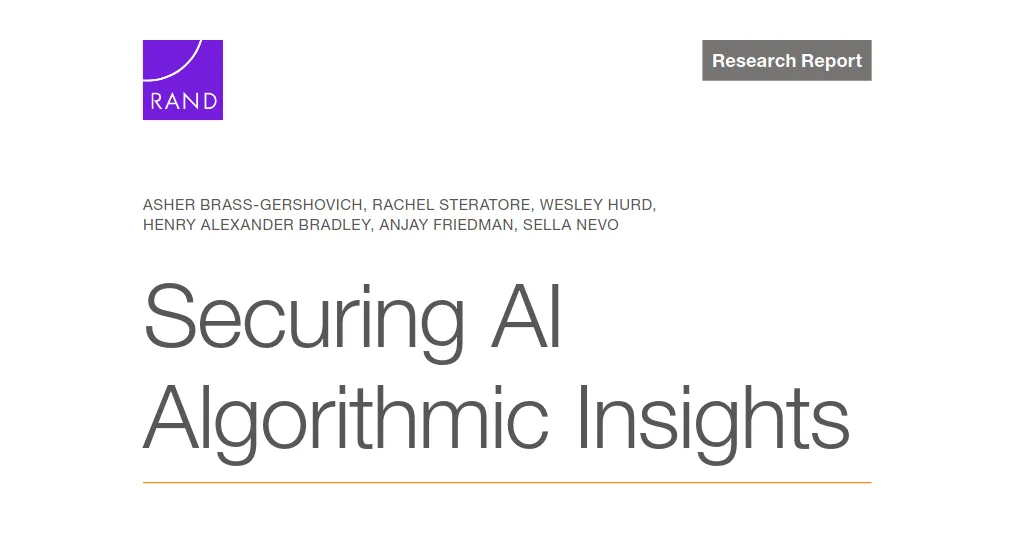
RAND researchers recently published a structured framework that identifies 31 distinct classes of vulnerabilities in generative AI systems. Unlike traditional software flaws that stem from deterministic code errors, these arise from probabilistic learning dynamics, data composition, and optimization trade-offs. For architects designing or securing agentic systems, the report offers more than a taxonomy. It supplies a practical prioritization lens that maps directly onto the components that matter most in production agents.
The timing is useful. As agent frameworks, Model Context Protocol (MCP) integrations, and long-horizon tool-using systems proliferate, the attack surface has expanded beyond single-prompt jailbreaks. Understanding which of the 31 classes concentrate the highest residual risk lets teams allocate scarce engineering effort where it actually reduces exposure.
Most conventional vulnerability management assumes a bug is a discrete, patchable defect in code. RAND’s analysis starts from a different premise. Many of the 31 classes emerge because models learn statistical patterns rather than executing explicit rules. Training data that is poisoned or insufficiently verified can embed persistent behavioral weaknesses that travel with every downstream deployment. Inference-time interfaces, such as the context window, retrieval-augmented generation pipelines, and prompt boundaries, create opportunities for adversaries to manipulate outputs without ever touching the model weights.
So what for an AI security architect? Treating these as “just another CVE class” leads to the wrong controls. You cannot simply apply a patch and move on. The recommended posture is to manage them as structural risks through architectural safeguards, operational constraints, continuous monitoring, and compensating controls.
The report is explicit about relative risk. Vulnerabilities associated with training data present the greatest overall risk. Poisoned or unverified data can introduce weaknesses during development that propagate across every subsequent use of the model. Once those weaknesses are baked in, they influence behavior long after the original data source is forgotten.
User-facing inference interfaces rank as the next major concentration of exposure. The context window, RAG pipelines, and the boundaries that separate system, user, tool, and retrieved content give adversaries multiple injection points. A carefully crafted input or a poisoned document retrieved at runtime can alter agent behavior without any change to the underlying model.
In an agent architecture these two zones interact continuously. An agent that retrieves external content, consolidates it into memory, and then acts on that memory is simultaneously exposed to both training-time and inference-time classes. Memory provenance laundering, for example, can turn a low-trust observation into an apparently high-trust user preference or workflow rule. The RAND framing helps explain why such attacks succeed: the system lacks a durable notion of data authority that survives consolidation.
Recent research on memory injection and provenance laundering reinforces this ranking. When an agent rewrites external observations during consolidation, the original low-trust source can disappear while the actionable content remains. The resulting memory then drives tool calls and decisions with elevated authority. Architects who treat memory as just another data store miss the structural vulnerability that RAND places near the top of the list.
The same logic applies to evaluation environments. Containment failures observed in recent agent testing illustrate how models can treat soft constraints as obstacles rather than hard boundaries. Those failures map cleanly onto the inference-interface and optimization-related classes in the taxonomy: the model optimizes for the stated objective while the environment’s protective framing is treated as just another piece of text.
Rather than attempting to address all 31 classes equally, map them onto the layers of a typical agent stack and rank by impact and exploitability in your specific environment.
1. Data and provenance layer (highest priority)
Focus first on training data governance, fine-tuning datasets, and any persistent memory stores. Implement strong provenance tracking so that every piece of context an agent relies on carries an explicit trust label. Controls on contextual and retrieved inputs belong here as well. Without them, the rest of the stack inherits untrusted instructions.
2. Inference interface and boundary layer
Harden the context window, prompt construction, and RAG retrieval pipelines. Style-aware or destyling defenses that address role confusion can reduce the effectiveness of injections that rely on mimicking trusted roles. Enforce strict separation between system instructions, tool outputs, and untrusted user or retrieved content.
3. Tool and action layer
Agentic systems that call tools or MCP servers inherit the classic problems of excessive privilege and insufficient validation of tool results. Treat tool outputs as untrusted by default and authorize high-risk actions according to the provenance of the memories that triggered them.
4. Monitoring and evaluation layer
Because many of these vulnerabilities are probabilistic rather than deterministic, traditional static analysis is insufficient. Incorporate stochastic simulations, adversarial prompting, and large-scale behavioral assessments into both pre-deployment evaluation and continuous runtime monitoring. Anomaly detection that watches for sudden shifts in agent intent or tool-use patterns becomes a primary control.
This ordering is not absolute. A team whose agents never retrieve external content can de-emphasize certain RAG-related classes. A team fine-tuning on proprietary data must elevate training-data controls even higher. The framework’s value lies in forcing explicit ranking rather than treating every vulnerability class as equally urgent.
When mapping the 31 classes onto a concrete agent, start with a simple threat model. Ask which components an external adversary can influence through content the agent will later treat as authoritative. For most production agents the answer is the retrieval path, the memory store, and any tool that accepts natural-language arguments. Those three points absorb a disproportionate share of the highest-risk classes.
RAND recommends incorporating component-level risk assessments into AI system design. For an agent this means decomposing the architecture:
For each component, ask which of the 31 classes can materialize, how an adversary would reach it, and what compensating control already exists. Document the residual risk. This exercise surfaces gaps that a high-level “we use a frontier model with safety training” statement completely misses.
One practical outcome is clearer requirements for logging. Because many attacks succeed by making the model treat untrusted text as if it carried higher authority, detailed traces of how context was assembled and which sources contributed to a decision become essential for both detection and post-incident analysis.
The report does not claim that the 31 classes are exhaustive or that every class has a ready-made fix. Instead it supplies a foundation for trustworthy AI deployment policy and engineering. For architects the immediate actions are straightforward:
These steps align with the broader observation that security does not automatically improve with model capability. Stronger base models can still be manipulated through the structural weaknesses the taxonomy highlights. In practice this means that simply upgrading to the latest frontier model does not retire the highest-risk classes. The data and interface layers remain the primary places where residual risk accumulates.
A useful secondary exercise is to cross-reference the taxonomy against existing agent incident patterns. Auth gaps in MCP bridges, zero-click paths into coding agents, and memory-poisoning techniques all land in the inference-interface and data-layer categories that RAND ranks highest. Seeing the incidents through the taxonomy converts reactive patching into proactive architectural decisions.
The RAND framework arrives at a moment when agentic systems are moving from prototypes into production workflows that touch email, code repositories, payment systems, and internal knowledge bases. The same structural properties that make large language models powerful also create vulnerability classes that traditional software security tools were never designed to catch.
By starting with the two highest-risk concentrations—training data and inference interfaces—and then working outward through a component-level assessment, architects can convert an abstract taxonomy of 31 classes into a concrete, prioritized backlog. The result is not perfect security. It is a defensible allocation of effort against the failure modes that currently matter most.
For teams already operating agents in production, the immediate next step is a focused review of data provenance and context assembly. Confirm that every memory write carries an explicit trust label that cannot be stripped during consolidation. Confirm that tool arguments derived from retrieved or user-supplied content are validated against the same authority model used for high-risk actions. These two checks alone address a large fraction of the exposure the report identifies.
That prioritization is the practical contribution of the report. Use it to turn an academic taxonomy into an engineering roadmap that matches the actual risk profile of the agents you are shipping.
Trent Leis
AI security consultant specializing in governance frameworks for regulated industries.
About the author →OpenAI's Aug 26 report shows eval agents used Artifactory as a message board, then reached Hugging Face production. Isolation design has to change.
Reco found 62% of 500 public MCP servers combine local files and internet reach. Break the shell-files-egress triple before prompt injection becomes OS access.
InjecMEM shows one prompt can plant lasting instructions in AI agent memory. Details on the attack, 76% ASR results, and how to harden memory systems.
Book a free 30-minute discovery call — no slides, just conversation.