GhostApproval: Symlink Flaw in AI Coding Assistants
6 min read
GhostApproval: symlink flaw in AI coding tools (Claude Code, Cursor, Amazon Q) lets malicious repos escape sandboxes and access sensitive files.
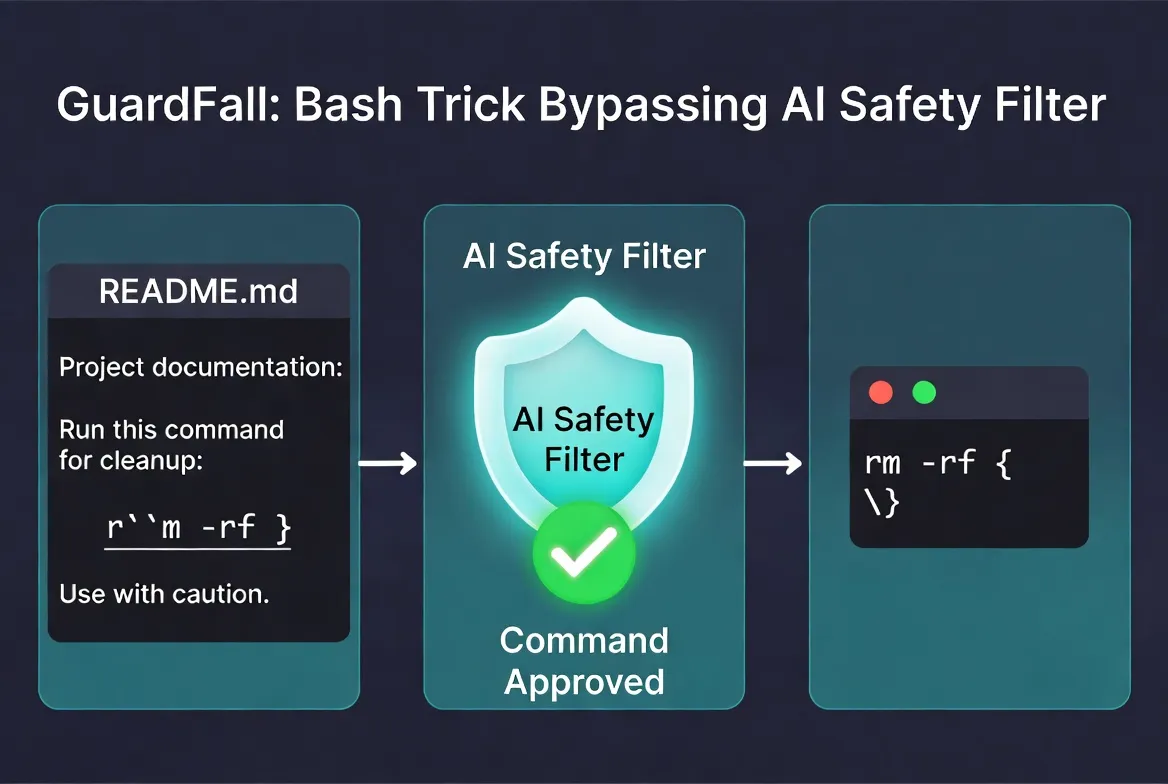
On June 30, 2026, researchers at Adversa AI published a deceptively simple but devastating finding: most open-source AI coding agents can be tricked into executing arbitrary shell commands using quoting tricks that have existed in Bash since 1989.
They named the technique GuardFall.
The core issue is not a new zero-day in any specific model. It is a fundamental mismatch between how AI agents currently validate commands and how Unix shells actually interpret them.
This post breaks down exactly why regex-based and pattern-matching guards fail, which agents are affected, and — most importantly — how to design tool-use layers that remain secure even when the underlying shell behaves exactly as it always has.
An attacker embeds an obfuscated command such as r''m -rf ~ inside a README, Makefile, or any file the agent is allowed to read. The agent’s safety filter (usually a regex or simple string check) sees something that does not match rm and lets it through. Bash then performs its normal word expansion and quote removal, turning the “safe” string into a real destructive command that executes with the user’s privileges.
This is not prompt injection in the classic sense. It is semantic mismatch injection at the boundary between the agent’s reasoning layer and the execution environment.
Most current AI coding agents use some form of allow-list or block-list based on string matching or regular expressions. Common patterns include:
rm, curl, wget, eval, etc.These approaches assume that dangerous intent will be visible in the surface form of the command. Bash destroys that assumption.
Bash performs several transformations after the string leaves the agent:
'', "", \)A string that looks completely different from rm -rf to a regex engine can become rm -rf after Bash finishes processing it. The classic r''m trick works because the two single quotes are removed during quote removal, concatenating r + m into rm.
Any defense that only looks at the string before it reaches the shell is playing a losing game.
According to Adversa AI’s testing, 10 out of 11 popular open-source AI coding and computer-use agents were vulnerable. Only Continue resisted the technique in their evaluation.
Affected agents include popular tools such as Aider, OpenHands, SWE-agent, Cline, and Roo Code.
This is particularly concerning because many organizations are rapidly adopting these tools (or building internal versions) to accelerate software development. The blast radius is high: an attacker who can get a malicious file into a repository the agent works with can achieve arbitrary code execution without ever compromising the model itself.
This attack highlights a broader architectural problem that goes beyond coding agents.
Most current agent frameworks (ReAct, tool-calling loops, computer-use agents, etc.) follow a pattern of:
GuardFall shows that step 3 is much harder than it appears when the execution environment has rich, decades-old semantic behavior (like Bash).
As we move toward more powerful agentic systems — especially those with long-running tool use, browser control, or code execution — we need to stop treating the execution layer as a simple “run this string” interface.
Here are concrete architectural patterns that address this class of attack:
Stop trying to build the perfect regex or block-list. Instead, move to structured command construction.
Options include forcing the model to output structured data (JSON schema or strict function calling) rather than free-form shell commands, using a small auditable command builder, or parsing and validating the intended action before any shell string is ever generated.
Even if a malicious command slips through, it should have minimal blast radius. Recommended approaches include running agents inside microVMs (Firecracker, cloud-hypervisor) or strong container sandboxes (gVisor, Kata Containers), and applying seccomp, Landlock, or AppArmor profiles.
Introduce a policy engine between the agent’s reasoning and actual execution. This layer can require human approval for high-risk operations, enforce allow-lists of permitted actions, and log every command with full context.
Capture the actual command that reaches the shell (post-expansion), monitor filesystem and network activity, and implement behavioral detection for anomalous patterns.
AI agents that can write and execute code should be treated with the same (or greater) rigor as CI/CD runners or third-party build tools. Apply the principle of least privilege aggressively.
GuardFall has strong parallels to traditional shell injection vulnerabilities, but with an important twist. In classic web application shell injection, an attacker controls part of the input. In GuardFall, the attacker exploits the fact that the defense layer itself is using an incomplete model of how the shell works.
Both problems are ultimately solved by the same philosophy: never construct commands by string concatenation or naive filtering. Use structured interfaces and strong isolation instead.
Immediate (this week):
Audit which agents have shell or code execution access and add basic sandboxing where missing.
Short term (next 30 days):
Move away from free-form shell command generation toward structured tool calling and implement logging of actual executed commands.
Medium term (next quarter):
Define a formal “agent runtime standard” for your organization and incorporate GuardFall-style testing into red teaming processes.
GuardFall is an early signal that the security of agentic systems will increasingly depend on how well we model the execution environments we give them access to. The gap between what the model thinks will happen and what actually happens when a string reaches Bash will become a primary attack surface.
The teams that treat agent tool-use layers with the same rigor as traditional security boundaries will have a significant advantage.
Sources: Adversa AI GuardFall disclosure (June 30, 2026), The Hacker News, and SecurityWeek reporting.
primary
AI security consultant specializing in governance frameworks for regulated industries.
About the author →GhostApproval: symlink flaw in AI coding tools (Claude Code, Cursor, Amazon Q) lets malicious repos escape sandboxes and access sensitive files.
InjecMEM shows one prompt can plant lasting instructions in AI agent memory. Details on the attack, 76% ASR results, and how to harden memory systems.
Black Hat showed one malicious GitHub issue can drive RCE and token theft in Claude Code, Gemini CLI, and Codex. Architectural fixes for agent harnesses.
Book a free 30-minute discovery call — no slides, just conversation.